
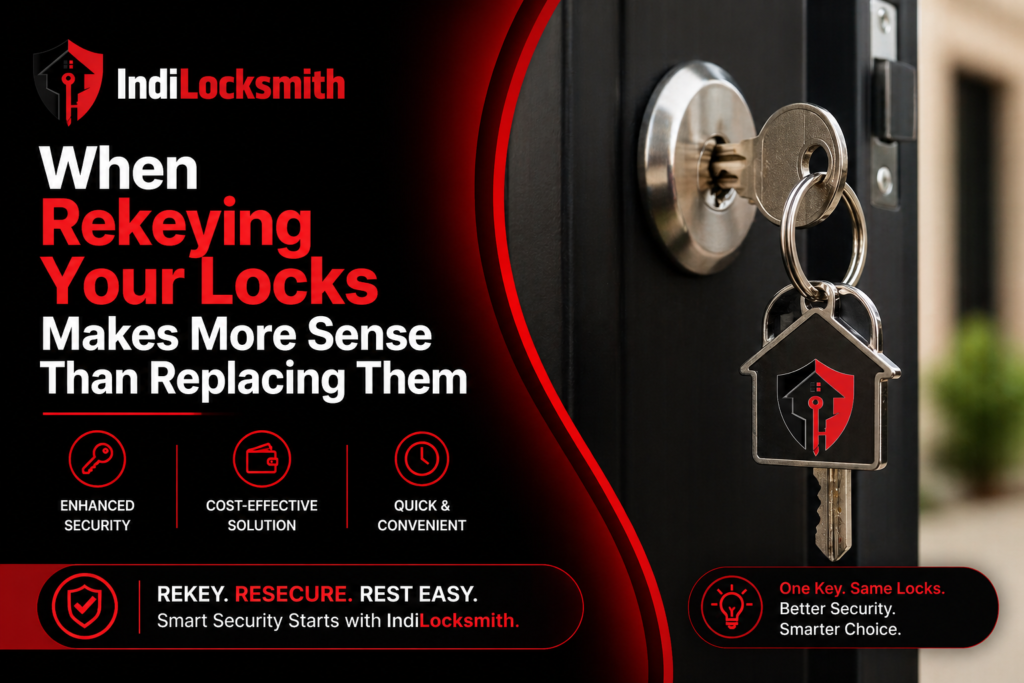
Many people assume that any lock-related problem automatically requires a full replacement. In reality, that is not always necessary. In many situations, rekeying is a practical and cost-effective way to improve security without changing the entire lock hardware. The key is understanding when rekeying is enough and when replacing the lock is the better long-term decision.
For homeowners and business owners alike, this choice often comes up after moving, losing keys, changing tenants, or dealing with employee turnover. The lock may still work perfectly well, but the question becomes whether the old keys should continue to work. That is where rekeying becomes especially useful.
What rekeying actually does
Rekeying changes the internal configuration of a lock so that the old key no longer works. The hardware on the door usually stays the same, but a new key is created to match the updated lock mechanism. From a security standpoint, this allows you to cut off access tied to previous keys without replacing the full lockset.
That makes rekeying a strong option when the lock itself is in good condition and the main concern is control over who has access. If the hardware is solid, functions well, and does not need an upgrade, rekeying can solve the problem efficiently.
Situations where rekeying makes sense
One of the most common times to rekey is after moving into a new home. Even if the previous owner handed over every key they had, there is no reliable way to know whether extra copies exist. Rekeying gives new homeowners a simple way to start fresh and feel certain that only their keys open the door.
It is also a smart option after losing a key. If there is any chance that the key could be connected to your address, vehicle, or business, rekeying helps reduce the risk that someone else could use it later. The same principle applies to rental turnover, office staffing changes, contractor access, or any situation where control over old keys becomes uncertain.
For businesses, rekeying can be especially valuable when access needs to change quickly without the expense of replacing multiple locks throughout the property.
When replacement is the better option
Rekeying is not the right answer for everything. If a lock is damaged, worn out, unreliable, or outdated, replacing it may be the better decision. A lock that sticks, jams, feels loose, or shows signs of failure may already be a weak point in your security. In that case, changing only the key setup does not address the larger issue.
Replacement also makes sense when you want to upgrade the level of security. For example, a basic lock may no longer meet your needs if you want stronger hardware, better resistance to forced entry, or a more modern access solution. In that situation, replacement is not just about access control — it is about improving the hardware itself.
Another reason to replace rather than rekey is appearance and functionality. If the lockset is old, mismatched, or no longer fits the style or needs of the property, a full update may be more worthwhile in the long run.
The security decision behind both options
Choosing between rekeying and replacing is ultimately about understanding what problem you are trying to solve. If the main issue is that old keys should no longer work, rekeying is often enough. If the lock itself is the problem, or if you want stronger security and better hardware, replacement is the better path.
This is why professional locksmith guidance can be helpful. What may look like a simple lock issue from the outside can involve wear, compatibility, or security weaknesses that are not immediately obvious. A proper assessment helps avoid spending money in the wrong place and ensures that the chosen solution actually improves peace of mind.
Better security does not always require a full change
Many customers are relieved to learn that they do not always need completely new locks to regain control over access. Rekeying can be a practical middle ground: more secure than doing nothing, faster and more affordable than replacement, and effective in the right circumstances.
For homes and businesses in Indianapolis, the best option depends on the condition of the current locks, the reason for the change, and the level of security you want moving forward. In many cases, rekeying is the smart answer. In others, replacement is the better investment. The value comes from choosing the solution that matches the real problem — not simply the most dramatic one.